Showing posts with label palermo. Show all posts

Monday, 16 September 2024

In the Kingdom of the Two Sicilies 8 – Falcone and Borsellino


As true fans of Inspector Montalbano [see previous post] will know, there is a strong link between his career and the assassination of magistrate Giovanni Falcone. If you don't know it, you need to check out the equally excellent prequel series, Young Montalbano.

Falcone – like Montalbano to a degree – rubbed up against the Mafia but in a much more intense and dangerous way in the all too real world. His campaign to bring the godfathers and mobsters to justice led inevitably to his being blown away in an horrendous bombing near Palermo.

A similar fate soon overtook his fellow magistrate and friend Paolo Borsellino in the city itself.

The gruesome deaths of Falcone and Borsellino seemed to help Sicily turn a corner and to start standing up to the Mafia. 

And today the two men are commemorated as martyrs to their cause.

It seemed important to visit the tomb of Falcone in Palermo's San Domenico church – even though the awful truth is that there was nothing left of him to bury.
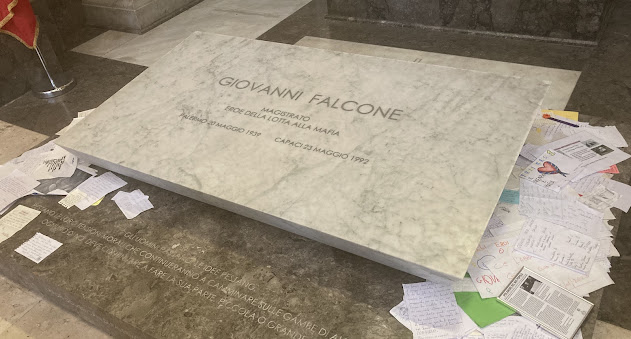
Falcone's tomb  ©Nigel Summerley


A lovely image of him and Borsellino decorates a tall building near the Palermo waterfront: two smiling men united in fighting a war that they well knew would most likely lead to their deaths.

Heroes are so often in short supply... but that is what these men were.
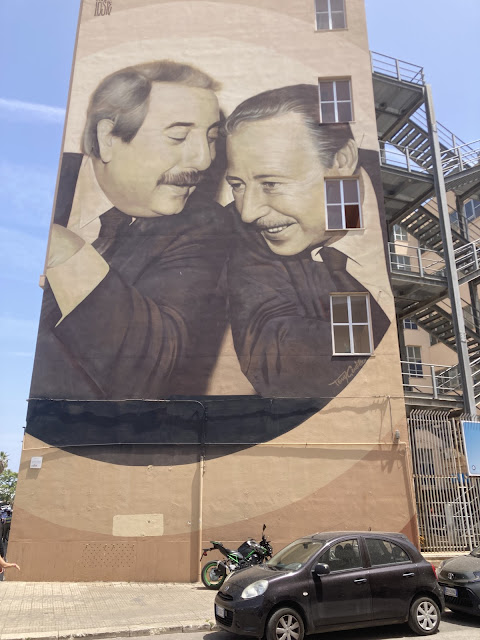
Immortalised: Falcone and Borsellino  ©Nigel Summerley

Monday, 29 July 2024

In the Kingdom of the Two Sicilies 5 – It's Italy, But Not As We Know It


© Nigel Summerley


Imagine being able to walk through a door in Italy and find yourself in Greece... For me, a lover of both, it sounds like a win-win.

And it's possible to do it (sort of) in the northern Sicilian town of Piana degli Albanesi.

Enter the church of San Giorgio and you are confronted with the starkly beautiful frescos (pictured above) and icons (below) of the Orthodox church, a world away from the often over-the-top decor of Italian Catholicism.

The reason for this anomaly is that Albanian refugees from the Ottoman Empire settled in this area from the 15th century onwards, bringing with them and preserving the Byzantine rites.

Because of this, the settlement was long known as Piana dei Greci, the name only being changed to Piana degli Albanesi in 1941 by Mussolini.

The Albanesi kept not only their religious practices but also their customs and language – which all help make the town a rare and fascinating experience. It's half an hour's drive south of Palermo but very much set in another time and place.

© Nigel Summerley


Friday, 26 July 2024

In the Kingdom of the Two Sicilies 4 – Market Forces

©Nigel Summerley


Palermo's La Vucciria market has changed a lot since Renato Guttuso painted his genuinely iconic picture of it [see this blog – An Odyssey in the Second Year of the Plague – Midnight in Sicily, 7 March 2021].

That image – probably not Guttuso's best but certainly his best known – crops up all over Vucciria. 

Everywhere you go, you will get a different story about the painting and what it represents. According to some, the artist put himself in it – some say as a young man, some say as an old man. They also say he included images of his wife and his mistress. But no one seems to know for sure whom those enigmatic figures represent...

The original is there for you to contemplate and draw your own conclusions at the Palazzo Chiaramonte, aka the Steri.

What is not in doubt is that Guttuso depicted a stunning cornucopia of foodstuffs for sale. But today the market has become a tourist magnet, with T-shirts, souvenirs and handbags taking the place of fish, fruit and vegetables.

And if you walk through the area at night, you will find yet another Vucciria: a dark, pulsating party alive with dancing, music, drinking and human noise, as if the place has entered another, wilder universe.

If Guttuso were to paint this contemporary nocturnal Vucciria, it would be very, very different from his original – but definitely just as sensual.


Friday, 28 June 2024

In the Kingdom of the Two Sicilies 3 – Bella... Bellissima


©Nigel Summerley


There seems to be something particularly grand about grandeur when it's a little faded, a little eccentric.

Hence, the appeal of La Bella Palermo, a palazzo property in Sicily's capital doubling as both a holiday let and a kind of living museum.

The place is lovingly curated by Francesco Cazzaniga, nephew of the owner – who is a collector of objets d'art both weird and wonderful.

With its five bedrooms and vast living areas, La Bella Palermo can be rented only by large families or groups – or couples or individuals who have a lot of money and want some palatial space to themselves.

Every day and night staying here offers up new discoveries. The rooms are so packed with paintings, books and upmarket bric-a brac, that there really never is a dull moment.

And apart from pretending that you're in The Leopard [see this blog – An Odyssey in the Second Year of the Plague – The Leopard, 15 March 2021], you are right in the beating heart of Palermo, a few paces from seductive little streets and the Vucciria market [see this blog – An Odyssey in the Second Year of the Plague – Midnight in Sicily, 7 March 2021].

La Bella Palermo is part of the Palazzo Pantelleria; originally a 14th-century fort, it was transformed into a palace in the 16th century.

More information: https://www.labellapalermo.com/

©Nigel Summerley


©Nigel Summerley


Monday, 3 June 2024

In the Kingdom of the Two Sicilies 1 – Dead Heat


This blog has covered Naples extensively – in the two series See Naples and Live and See Naples and Live More – but it hasn't touched on the fact that for the first six decades of the 19th century the city was the capital of what was known as the Kingdom of the Two Sicilies.

The two Sicilies – the whole of southern Italy and the island of Sicily – constituted a kingdom under the rule of the Spanish Bourbon royal family until the unification of Italy.

That unification was a forced marriage of northern Italy and the south which remains a strained relationship even today.

The Kingdom of the Two Sicilies – the south and Sicily – still feels like a different country to that of Rome and Milan.

After spending time in Naples, one can't help finding Palermo to be something of a tribute act to that greater city. Palermo has the churches, the art, the markets, the food, the narrow back alleys, the history of mafia wars and bodies in the streets, and the juxtapositions of light and dark, of life and death... but somehow it doesn't come close to the edginess and perversity of Naples.

However, there's one Napolitan-style aspect in which Palermo can chalk up at least a draw: Naples has catacombs and cadavers aplenty (see this blog See Naples and Live) but the catacombs of the Capuchins in Palermo are a genuinely stunning near-death experience for the visitor.


It all started with the Capuchin monks preserving their fellows' bodies, but in the 19th century it became a fashionable thing to do to have you and your family put on show rather than buried.


Hundreds and hundreds of skeletons hang here in row upon row, many still dressed in their best clothes. In some cases, the clothes have worn much better than their occupants – the material of a dress still has its colour, the fabric still holds together...


The inescapable message is that death comes for all of us... it's the ultimate levelling up. Or maybe that should be levelling down.


They are all here: men, women, old, young... little toddlers in their toddler clothes. Nameless but every one the remainder of a life just like yours or mine or Biden's or Trump's...


Many were plague victims, so sometimes you will be confronted by whole families of skeletons with father, mother and children – all dressed for life but now long dead.


It's unmissable and only €5 to enter. Although I'm not sure what to think about the fact it's free for under-sixes. We all need to face up to death – but maybe that's just a tad too early to be forced to do it?

Sunday, 7 March 2021

An Odyssey in the Second Year of the Plague – Midnight in Sicily


Peter Robb's sprawling book Street Fight In Naples (see this blog An Odyssey in the Second Year of the Plague – Street Fight In Naples) provides some wonderful insights into that city's amazing history, but his later Midnight In Sicily is more focused and even better.

The mafia, politics, violence and corruption loom large – it's about southern Italy after all – but, as with the previous book, there is also much about art.

And especially the remarkable Renato Guttuso, a maverick in the Picasso mould, whose life and – especially – death were bound up with those themes of politics, corruption and organised crime.

His relationship (both artistic and intimate) with his muse, Marta Marzotto, is love story, soap opera, scandal and tragedy, all wrapped up together, and Robb's interview with Marzotto herself is a wonderful piece of theatre.


Guttuso's passionate style managed to make La Vucciria (above), his 1974 study of Palermo's market, as much about hunger as about food. And his many erotic studies of Marta Marzotto (below) encompassed a furious desire as well as an appreciation of beauty.