Saturday, 19 February 2022

See Naples and Live – 25: The End of Another Odyssey

©Nigel Summerley


When I saw this reproduction head in an antiques shop window in Naples, it was like meeting an old friend.

It's Odysseus of course – a very old friend. I had last encountered this depiction of him during my 2020 trip when I visited Sperlonga on Italy's Odyssean Coast [see this blog An Odyssey in the Year of the Plague – 12: 22-28 September 2020].

As I've mentioned before, there is a big connection between the travels of Odysseus and the west coast of Italy, but it was still a lovely surprise to find him here in the heart of Naples.

And the slow train that finally took me from Naples back to Rome a few days later afforded me a glimpse of one of the most magical places from my own odyssey in 2020 – and from that of Odysseus many, many centuries before.

It was Monte Circeo... once an isle where the sorceress Circe was said to have roamed, but now a promontory, even though it still looks like an island [see this blog An Odyssey in the Second Year of the Plague – Islands, 9 January 2021].

Glimpsed from a train window... Monte Circeo,
the isle of Circe
 ©Nigel Summerley


After that, I rode the train into the sunset... and my wonderful adventures in Naples came to an end...

©Nigel Summerley


Thursday, 17 February 2022

See Naples and Live – 24: Buona Notte


©Nigel Summerley
I love Naples. It's as simple as that. New York, London, Paris, Rome, Amsterdam... they're all amazing in their way. But they have nothing on Napoli.

In this series of Neapolitan blogs I've hardly mentioned Vesuvius, that looming ever-presence that reminds the city of the thin line between life and death, between today and perhaps no tomorrow.

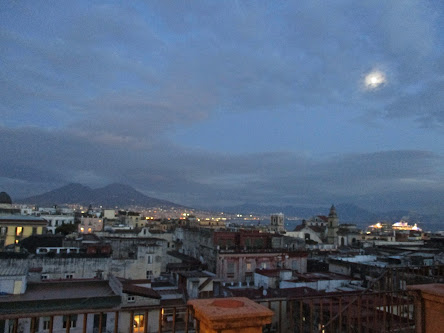
When my friend Z and I emerged from our Hermann Nitsch experience [see this blog See Naples and Live – 13: Bloody Weird, 18 November 2021], this was the view of the rooftops of Naples that we saw, with shadowy Vesuvius on the horizon and a bright moon glowing through the evening clouds. It was a perfect moment... a marvellous way to take in this perfectly imperfect city... which was so hard to say goodbye to.

Monday, 7 February 2022

See Naples and Live – 23: Personal Drainers

©Nigel Summerley


The worst job you ever had is probably nowhere near as bad as that of those who once laboured in the Neapolitan catacombs of San Gaudioso in the 17th century. 

God knows how, but the monks who ran the place came up with a novel way of preserving the well-off dead for posterity – and making some extra money in the process.

Down beneath the church of the Basilica Santa Maria della Sanita in Naples, I was shown the stone benches where the corpses of the rich used to be sat against the wall and then (with buckets placed beneath them) punctured to drain off all their fluids.

This process took a while apparently, so the body drainers, the schiattamuorti, sometimes had quite a few customers sitting in a row, waiting to be fully desiccated.

It must have been like working in some sort of a cross between a care home and Hell.

There was no fresh air coming into the catacombs – apart from when trap doors above were opened to lower a new corpse into place. The lack of ventilation combined with the noxious effects of exposure to decomposing bodies meant the lives of the schiattamuorti were constantly at risk.

When one of the dead was thoroughly dried out, the body was buried, but what remained of its precious head was stuck in the walls of the catacombs; and then a bizarre portrait of a skeleton wearing the clothes of the deceased was painted beneath it.

This ritual continued for several decades before someone noted how unhygienic – not to mention slightly unhinged – it was and the practice was brought to an end.

All the bones were eventually removed from the catacombs along with the front halves of the skulls on display. As you'll see from these pictures, the remains of the skulls – and the accompanying frescoes – are still very much visitable and visible.

The Catacombs of San Gaudioso present a weirdly wonderful cocktail of life, death and superstition...  just like Naples itself.


©Nigel Summerley


©Nigel Summerley

Tuesday, 1 February 2022

See Naples and Live – 22: Underground Religion


San Gennaro Catacombs ©Nigel Summerley


I've already touched on some of the history of the unfortunate San Gennaro [see this blog 26 December 2021, See Naples and Live – 20: Bones and Blood] who had his head removed by the Romans in Pozzuoli near Naples in the 4th century because he was a fervent Christian.

His body and his head – and allegedly his blood – all travelled around quite a bit. But in the 5th century most of his remains were brought to Naples and buried in the catacombs that today still bear his name.

Four centuries later those remains were stolen and removed to the town of Benevento which also had a claim on the poor man.

In 1497 the saint's bones were finally returned to Naples – where some of them can still be seen in the Cathedral.

But more atmospheric by far are those Catacombs of San Gennaro – in the Sanita district – where not only he but many of the early Christians were entombed while they waited for their expected resurrection.

The Catacombs are a long way out from the centre of the city and not brilliantly signposted – in fact, not really signposted at all. But don't be put off. The locals are used to confused visitors wandering about and they happily dispense directions, often without being asked. Sometimes they just smile and point...

The remains of Gennaro are no longer here, of course, but you can see the tomb where he was once laid – and the many niches in which his fellow Christians were sealed up – and marvel at this underground cemetery whose structure also served as an atmospheric church.

Some of the intensity of the lives of these followers of Jesus can be picked up from exploring this subterranean sepulchre – but it is nothing to the eerie nature of the Catacombs of San Gaudioso, also in Sanita and also to be featured shortly in this blog.

San Gennaro Catacombs ©Nigel Summerley


Monday, 3 January 2022

See Naples and Live – 21: Breasts or Testicles?

©Nigel Summerley

While I was reading a century-old book relating the story of the Hittite empire, a reference to "Artemis of the Many Breasts" reminded me of one of the most curious sights in Naples' National Archaeological Museum – pictured above.

My first thought on seeing her was certainly that this was a goddess with a profusion of breasts. But when I read the accompanying notice, I was informed that these were in fact bulls' testicles and thus symbols of fertility.

Either way, this was a pretty weird image. But I was sold on the testicles, and stuck to that explanation when showing this photograph to other people.

However, now it doesn't seem to be quite so clear-cut. The breasts explanation held sway for a very long time in the past – so much so that one statue of the goddess had multiple jets of milk-like liquid spurting from every protuberance (not dissimilar to the Naples fountain depicting Parthenope – see this blog 23 November, See Naples and Live – 14: Sirens, Sirens Everywhere...).

One argument for the testicles, though, is that if these were the goddess's breasts, surely they would be coloured dark, to match her face and hands? Their distinctly different colouring suggests that they are indeed testicles detached from their bovine owners to be made into fashion accessories with a religious significance.

Whatever the truth, this stunning statue remains just one of myriad reasons to visit a museum overflowing with marvels.

Sunday, 26 December 2021

See Naples and Live – 20: Bones and Blood

Bones of San Gennaro

The Christian martyr and patron saint of Naples – San Gennaro, or St Januarius – lost his head when the Romans executed him in nearby Pozzuoli around 305AD. But his remains have refused to die...

They were preserved for 500 years in Neapolitan catacombs (of which more in another post soon) until the body was purloined by the nearby rival city of Benevento.

The head, however, stayed behind in Naples and the body was finally returned there to join it in the 15th century. The remains of both are reckoned to be housed in the city's Cathedral  – along with phials of the saint's blood, collected by a devotee when the original decapitation took place.

The bones are – rather indecorously – displayed in a bin in the Cathedral crypt, while the skull is said to be contained in a bust of the saint, in a chapel off the main part of the church.

But it's the blood of San Gennaro that is the big deal...

On assorted holy days, the blood is brought closer to the remains of the head and the solid dark mass turns into liquid red blood. It pretty much happens without fail... and reassures the faithful of Naples that their saint is still with them and still capable of bringing about miracles.

I hesitate to be cynical about this – especially as I've just read The Mystery of Naples, a 1909 book by Edward P Graham devoted to debunking all the non-miraculous explanations for the liquefaction that have been forward by the many doubters. 

But methinks he may protest too much...

Bust of San Gennaro


Thursday, 16 December 2021

See Naples and Live – 19: Brave Art

If you look at the picture below, you'll get some idea of the scale of the picture above – ie huge.


Street art like this is another of the factors that makes Naples a constantly surprising city. This gorgeous example featuring a couple embracing is actually painted on the back of a lift that can take you down from the top of the Sanita bridge into the heart of this most Neapolitan part of Naples.


The large wall (above) covered in a mysterious (to me anyway) painting is also in Sanita. It seems to include Mary and Jesus and some sort of exorcism/rebirth. Whatever it is, it stops you in your tracks.

As does the gargantuan double portrait (below), again in Sanita.


My favourite so far, though, is another double-header (below), dominating a street in the Universita area. 


None of these works are slapdash quickies – they've obviously taken a lot of planning and a lot of hard work. And that's why they give so much pleasure to so many – day after day.