Showing posts with label David Abulafia. Show all posts

Saturday, 27 August 2022

Boundless Unenthusiasm

I mentioned The Boundless Sea on this blog back in 2021 – and wasn't too complimentary about it, since I felt it didn't quite live up to the over-the-top plaudits published on its cover.

At that point I was only 200 pages in... but now I've finished the other 700...

It was a close run thing, since David Abulafia's water-based great tale is distinctly, er, dry.

It's a remarkable – if ultimately rather dull – book. But it does do a good job of chronicling humanity's greed, violence and selfishness – all, sadly, the drivers of so much of the nautical exploration and adventures catalogued here.

Abulafia often speeds through complex and momentous events, but for some reason he always finds a little time to rubbish Thor Heyerdahl. He discounts the Norwegian adventurer's theories about westward migration across the Pacific from the Americas – and then dismisses him as a "self-publicist".

I know only a few things about Heyerdahl. But they include the fact that he put his life on the line more than once to test his theories... and he was a bloody good writer...

And Heyerdahl's books have all the passion that The Boundless Sea lacks.


Sunday, 9 May 2021

An Odyssey in the Second Year of the Plague – Krakatoa


Becalmed on David Abulafia's books about the sea and drifting away from Dante (see previous blogs), I was rescued by a chance encounter with Simon Winchester's Krakatoa, an excellent book that would actually justify some of the hyperbole sprinkled over the covers of The Great Sea and The Boundless Sea.

Winchester's subject matter helps of course... the most cataclysmic explosion known in modern times... the total self-destruction of an island of six cubic miles... a sound that could be heard 3,000 miles away... and deadly tsunamis with waves up to 135ft high...

But it is his journalistic approach to all that led up to the traumatic event of 1883, the very human details of what happened, and the life-changing aftermath that makes this such a fantastic read.

Above all, Krakatoa is an illustration of the immense intelligence of the planet, the fact that human existence hangs by a thread, and the reassurance that nature and its life forces will always be unstoppable.

Thursday, 29 April 2021

An Odyssey in the Second Year of the Plague – The Great Sea


The other problem with The Boundless Sea (see this blog 27 April 2021) is that it's not exactly boundless. The Mediterranean, I soon found (and yes, I should have checked earlier), is completely out of bounds – because it's covered in David Abulafia's companion book, The Great Sea.

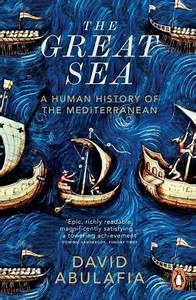
The Great Sea sees the same hyperbolists from the cover of The Boundless Sea at it again: Dominic Sandbrook finds it "magnificently satisfying"; and Simon Sebag Montefiore says it's "gripping".

So far, I haven't found it either of these... but it does seem to have a livelier opening than that of The Boundless Sea. And it covers many of the places that I have a passion for, so I'm setting sail in the hope of discoveries that may justify those cover lines...

Tuesday, 27 April 2021

An Odyssey in the Second Year of the Plague – The Boundless Sea


After getting bogged down in Dante (see this blog 29 March 2021), I decided to take a break and head for the open sea with David Abulafia.

Should one judge a book by its cover? This one quotes Peter Frankopan in The Sunday Times as saying the contents are "breathtaking"; Dominic Sandbrook, also from The Sunday Times: "dazzling"; and Simon Sebag Montefiore in The Daily Telegraph: "intense and thrilling".

All of which leads me to wonder if any of them have read it from the beginning...

Admittedly, I'm only 200 pages in – and it may get a bit livelier in the next 700 pages – but to me it feels like sitting in a history lesson where so many facts are being fired off at you that you're torn between trying to catch every word... and nodding off.

It may be about the story of humans and their vast watery planet – but it feels, well, so far rather dry...